
WordPress Site Gambling Hack: Causes, Signs, and Solutions
A WordPress gambling hack is an attack where criminals break into your site and inject casino, slot, and betting content, links, or redirects to borrow your site’s search reputation. It usually enters through an outdated plugin or theme, a stolen password, or a pirated extension. The fix is to find every infected file and database entry, close the entry point, change every credential, and then ask Google to review the site.
Key takeaways
- Gambling spam is a black hat SEO attack. Hackers use your site’s authority to rank their own betting pages.
- Much of it is hidden from you. The spam is often shown only to search engines, so your site can look normal while Google lists casino pages under your domain.
- Most entry points are plugins and themes, not WordPress itself.
- Spam hides in files and in the database, and a cleanup that misses a backdoor lets it return within days.
- After cleanup, request a review in Google Search Console so warnings and search penalties can be lifted.
Few things are more alarming than searching for your own business and seeing slot machine and casino pages listed under your domain. Your homepage may look fine, your forms may still work, and yet Google shows a different story.
This guide explains what a WordPress gambling hack is, how hackers get in, how to confirm an infection, and how to clean it properly so it stays gone.
What Is a WordPress Gambling Hack?
Online gambling spam is a form of black hat SEO. Attackers break into a trusted website and add content that promotes offshore casinos, sportsbooks, or betting sites. That content can be injected links, keyword stuffed pages, doorway pages, or redirects.
The goal is simple. A site with a clean history already has authority with Google. Hackers borrow that authority so their gambling pages rank faster than they could on a brand new domain.
It is also common. Sucuri’s researchers analyzed 422,741 websites affected by SEO spam in 2024 and found that nearly 19 percent, or 79,817 sites, were specifically injected with gambling related spam, including Korean and Indonesian campaigns.
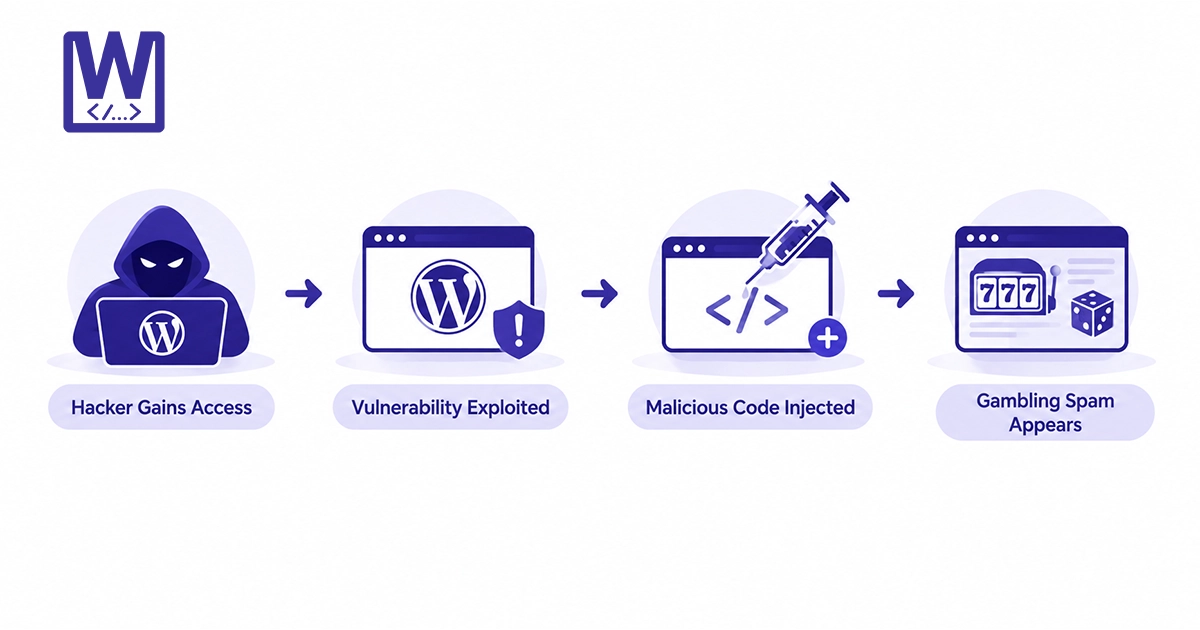
How Hackers Get In: The Common Causes
Vulnerable plugins. This is the leading cause. In Patchstack’s 2026 report covering 2025, 91 percent of newly reported WordPress vulnerabilities were in plugins, 9 percent were in themes, and only 6 were in WordPress core. Many of those flaws can be exploited without a login, and nearly half had no fix available when they were first made public.
Outdated software. Fixes exist for most vulnerabilities, but sites stay exposed when updates are delayed. Attackers scan the web for known flaws and exploit them quickly after they are disclosed.
Pirated themes and plugins. Nulled premium items are a classic way to install malware on your own site. The “free” download often comes with a backdoor.
Fake or abandoned plugins. Security researchers have documented fake plugins disguised as security tools that inject casino spam into a site’s footer. Abandoned plugins that no longer receive updates are another quiet risk. A widely reported example from 2014 involved a popular slider plugin that was bundled with many themes and went unpatched on thousands of sites.
Weak or stolen credentials. Reused passwords, leaked hosting logins, and unprotected admin accounts give attackers a direct way in with no vulnerability needed.
Old accounts left active. Former developers, freelancers, and test users with admin access are a common blind spot. Unused admin, FTP, database, and hosting credentials should be removed.
Weak hosting isolation. On poorly isolated shared servers, an infection on one site can spread to others on the same account.
How the Spam Gets Hidden
Understanding where the spam hides explains why cleanups fail.
Cloaking. The hack shows spam to search engine crawlers and a normal page to everyone else. That is why owners often do not notice anything wrong for weeks.
Injected files. Attackers modify theme files such as the footer, add new files in the uploads folder, or even replace core files like index.php.
Database spam. Some attacks store spam inside the database, in posts or in the options table, instead of in files. This makes them harder to find with a file scan alone.
Doorway pages and fake sitemaps. Hackers create hundreds or thousands of spam pages and may add them to your sitemap so Google finds them quickly.
Hidden links. Links to casino sites are placed off screen with CSS so visitors never see them but search engines do.
Geo targeted redirects. Visitors from certain countries are sent to gambling or scam pages, while visitors from your own location see nothing unusual.
Backdoors and rogue admins. Attackers often leave a hidden way back in, such as a new administrator account, a scheduled task, or a file that re installs the spam after you delete it.
Signs Your WordPress Site Has a Gambling Hack
| Where You Notice It | What It Looks Like |
|---|---|
| Google Search Results | Gambling words like slot, casino, judi, poker, or betting appear in your page titles or descriptions. |
| Search Console | A security issues warning, or sudden queries and impressions for gambling terms you never targeted. |
| Your Site | Random redirects to betting sites, especially on mobile or from search results. |
| Your Pages | Odd links in the footer or sidebar, or posts you did not write. |
| Your Dashboard | New administrator accounts, plugins you do not recognize, or changed files. |
| Your Hosting | Traffic spikes, high server load, or alerts from your host about malware. |
| Browsers and Tools | Warnings that your site is deceptive or unsafe, or blacklist flags in scanners. |
How to Check Your Site Right Now
- Search Google for your own domain plus spam words. Try site:yourdomain.com slot, site:yourdomain.com casino, and site:yourdomain.com judi. Pages you did not create are a strong sign of infection.
- Open Google Search Console. Check the Security Issues report and review the Performance report for unfamiliar gambling queries.
- Check your users. In the WordPress dashboard, look for administrator accounts you do not recognize.
- Run an external scan. Free tools such as Sucuri SiteCheck can flag known malware, hidden links, and blacklist status.
- Compare what Google sees with what you see. Because of cloaking, a clean looking homepage does not prove the site is clean.
What to Do Right Away
- Take a full backup of the hacked site before changing anything. You will want it for investigation, and it should be kept separate from your clean backups.
- Put the site in maintenance mode if spam is visibly reaching visitors.
- Change every password for hosting, FTP, the database, and all WordPress users.
- Tell your host. They may be able to scan the server and spot other infected accounts.
How to Clean a Gambling Hack Step by Step
- Contain the damage. Back up the infected site, then limit access while you work.
- Reset all credentials and security keys. That includes hosting, FTP, database, email, and every WordPress login, and refreshing the salts in your configuration file so existing sessions are logged out.
- Remove rogue users. Delete unknown administrators and review every account’s role.
- Replace WordPress core files with a fresh copy from the official source instead of trying to edit infected ones.
- Reinstall plugins and themes from trusted sources. Delete anything unused, abandoned, or pirated. Do not copy old files back over clean ones.
- Inspect the places malware loves to hide. That includes the uploads folder, theme files such as the footer and functions file, the htaccess file, scheduled tasks, and special plugin folders that load before normal plugins.
- Clean the database. Search posts, pages, and the options table for injected scripts, spam links, and unauthorized content, and delete spam posts and their related metadata.
- Find and close the entry point. If you only clean the symptoms, the same hole stays open. Update or remove the vulnerable plugin, theme, or account.
- Remove spam pages from your sitemap and your site, and make sure deleted spam URLs return a proper not found or gone response.
- Request a review from Google. After the site is truly clean, open the Security Issues report in Search Console and submit a review request. Do this after cleanup, not before.
Cleanups most often fail because of a missed backdoor. If the spam returns days later, assume something still lets the attacker back in.
How to Prevent It From Happening Again
- Update everything on a schedule. Core, plugins, and themes. Turn on automatic updates for trusted plugins where it makes sense.
- Keep your plugin list short. Every plugin is extra code that can contain flaws. Remove anything you do not use.
- Never use nulled themes or plugins. Buy or download from the original source.
- Use strong, unique passwords and two factor login for every admin account.
- Limit admin access. Give people only the role they need, and remove accounts when people leave.
- Add a firewall and malware scanning. Services from Sucuri, Wordfence, or a managed host can block many attacks and flag file changes early.
- Back up offsite and test restores. A clean backup turns a disaster into an inconvenience.
- Monitor Search Console. Security alerts and sudden query changes are often your first warning.
What a Hack Costs Your Business
A gambling hack is not only a technical problem. Spam pages can push your real pages down in search, browsers may warn visitors away, and customers lose trust fast when they see casino links under your brand. Every week the site stays compromised, your website lead generation suffers, because fewer people find you and fewer of those who do feel safe contacting you.
Recovery is a mix of cleanup, rebuilding trust, and getting search visibility back. The sooner the site is clean and Google has reviewed it, the sooner calls and inquiries recover.
Should You Clean It Yourself or Get Help?
A careful owner can clean a simple infection. Get professional help when:
- The spam keeps coming back after you clean it
- Many files or thousands of pages are affected
- You cannot find the entry point
- The site is critical to your revenue and downtime is costly
- Your host has suspended the account
In some cases, rebuilding on a clean install is faster and safer than hunting through years of accumulated plugins and files. If your site is also dated or slow, professional website design services can combine the rebuild with a stronger, faster site.
Frequently Asked Questions
What is a WordPress gambling hack?
It is an attack where hackers inject casino, slot, or betting content, links, or redirects into a WordPress site to borrow its search authority. The spam is often hidden from site owners and shown only to search engines.
How do gambling spam keywords get into my WordPress site?
Most often through a vulnerable or outdated plugin or theme, a stolen or weak password, or a pirated extension. Once inside, attackers add spam to files or the database and often leave a backdoor so they can return.
How do I know if my site has gambling spam?
Search Google for your domain plus words like slot, casino, or judi, check the Security Issues report in Google Search Console, look for unknown admin users, and run an external scan. A clean looking homepage does not prove the site is clean, because the spam is often cloaked.
Why does the gambling spam keep coming back after I delete it?
Usually because a backdoor or an unpatched vulnerability remains. Attackers often leave a hidden file, a rogue admin account, or a scheduled task that re installs the spam, so cleanup has to include finding and closing the entry point.
Will Google penalize my site for being hacked?
Google may flag the site or lower visibility of affected pages while the spam is present. Once the site is clean, you can request a review through the Security Issues report in Search Console so warnings can be reviewed and lifted.
How can I protect my WordPress site from gambling spam?
Keep core, plugins, and themes updated, remove unused or pirated extensions, use strong unique passwords with two factor login, limit admin accounts, run a firewall and malware scanner, and keep tested offsite backups.
Final Thoughts
A WordPress gambling hack feels sudden, but the cause is usually quiet and ordinary: an outdated plugin, a reused password, or a pirated theme. The good news is that it is fixable. Confirm the infection, clean files and database, close the entry point, change every credential, and ask Google to review the site.
Prevention is cheaper than recovery. Regular updates, fewer plugins, strong logins, and monitoring make most of these attacks fail.
Webrammer is a website design company in Honolulu serving businesses across the United States, and our website maintenance service is built around keeping sites updated, secure, and running smoothly. If you want help reviewing a suspicious site or preventing a repeat, you can book a free consultation or call us at 808-824-3555. If a site needs more than a cleanup, our website design and development team can rebuild it properly.


