
Why Your Website Isn’t Appearing on AI Search Results
A business owner told us something that stuck with us. She had spent years ranking on page one of Google for her services. Then a customer mentioned, during a friendly conversation, “I asked ChatGPT who to call, and your competitor came up but not you.”
Her website was fine. Her rankings were fine. She just wasn’t in the answer.
If that sounds familiar, you’re not imagining it. People now ask questions in ChatGPT, Gemini, Perplexity, Microsoft Copilot and Google’s AI Overviews, and they often get one summarized answer with a few sources instead of ten blue links. If your business isn’t one of those sources, you’re invisible to a growing number of buyers at the exact moment they’re deciding.
This guide explains, in plain language, why that happens and what you can do about it. If you’d rather have a team look at your site directly, our AI search optimization services cover everything below.
What “AI search visibility” actually means
AI search visibility is how often your business, brand or content is mentioned, cited or linked when AI-powered tools answer questions related to what you offer.
It’s different from classic rankings in one important way. Traditional SEO asks, “Where does my website rank?” AI search asks, “Is my website trustworthy and clear enough to be used in the answers?”
You can rank #3 on Google and still never be mentioned by an AI assistant. The reverse can also happen, where you may appear on AI search results but not on Google search results.
Why your website isn’t appearing on AI search results
Here are the most common reasons we see, roughly in order of how often they cause problems.
1. AI crawlers can’t reach your site
This is the “is the door even unlocked?” problem, and it’s more common than people expect.
- Your robots.txt file may block AI-related crawlers (for example, those used by OpenAI or Perplexity) without anyone on your team realizing it.
- Your security tool, CDN or firewall may be treating legitimate bots as threats.
- Key content may sit behind logins, pop-ups or heavy JavaScript that crawlers don’t render.
Quick check: open yourwebsite.com/robots.txt and read it. If you see broad “Disallow” rules you don’t understand, ask your developer what they’re blocking and why.
One honest note: blocking some AI crawlers is a legitimate business choice, especially for publishers. Just make sure it’s a decision you made on purpose and not an accident.
2. Your pages are vague about who you are and what you do
AI systems work by recognizing entities: clearly identified businesses, people, places and services. If your site says “we deliver innovative solutions” but never states what you sell, where you operate and who you serve, there’s nothing concrete to pull into an answer.
Compare these two lines:
- Vague: “We provide tailored solutions for modern businesses.”
- Clear: “We’re a web agency in [City] that builds and optimizes websites for local service businesses.”
The second one can be quoted. The first one can’t.
3. You don’t show real experience or expertise (E-E-A-T)
Google’s quality guidelines talk about E-E-A-T: Experience, Expertise, Authoritativeness and Trustworthiness. AI tools tend to favor sources that look like they come from real people with real knowledge.
Signals that help:
- Named authors with short bios and relevant credentials
- First-hand detail: what you tested, what happened, what you’d do differently
- An About page, contact details and a real business address
- Customer reviews and case studies you can stand behind
- Sources cited for any statistics you use
Signals that hurt: anonymous posts, generic content that could have been written for any company, and claims with no evidence.
4. Your content answers keywords, not questions
AI assistants respond to full questions: “Which web agency is best for a small dental clinic?” or “Why is my site not showing up in ChatGPT?”
If your pages are built around keyword phrases but never directly answer a real question in a clear sentence or two, you’re harder to cite. Content that does well in AI answers usually:
- States the answer early, then explains it
- Uses clear headings that mirror real questions
- Defines terms simply
- Is specific (numbers, steps, examples) instead of general
5. Missing or broken structured data (schema)
Schema markup is a small block of code that tells machines, in a standard format, “this is a business, this is its address, this is an article, this is the author, and these are the FAQs.”
It doesn’t guarantee you’ll be cited. But without it, systems have to guess what your page means. Pages with accurate schema are easier to interpret correctly.
Common problems: no schema at all, schema that contradicts what’s on the page, or outdated details such as an old phone number.
6. Nobody else mentions you
AI tools don’t rely only on your website. They draw on the wider web: directories, news mentions, industry lists, review sites, forums and social platforms. If your business exists only on your site, it looks unverified.
Consistent business details (name, address, phone, services) across Google Business Profile, directories and social profiles help confirm that you’re real and who you say you are.
7. Your site is slow, thin or out of date
Outdated pages, thin “doorway” content and slow load times all reduce trust. If your most important page was last updated in 2021 and says “in 2022 we plan to…”, that’s a signal too.
8. You’re not in the search indexes AI tools lean on
Many AI search features use traditional search indexes as a starting point. If your site isn’t properly listed or indexed by Google or Bing (because of noindex tags, canonical errors, broken sitemaps, or duplicate content), AI tools that rely on those databases may never see you. Submitting a clean sitemap in Google Search Console and Bing Webmaster Tools is the basic step but often skipped.
A simple self-check
Spend 15 minutes on this today:
Write down what you find. This becomes your baseline.
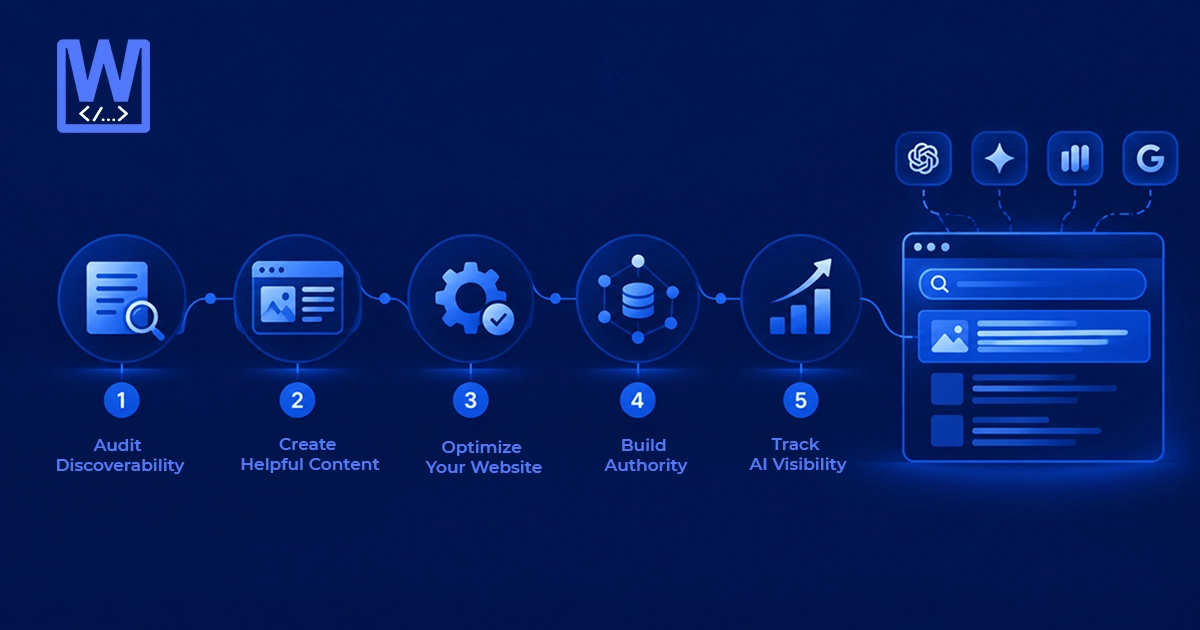
How to improve your visibility across AI-powered search platforms
Now the practical part. Work through these in order.
Step 1: Fix access first. Confirm crawlers can reach and read your important pages. Fix robots.txt, firewall rules and indexing errors before anything else.
Step 2: Make your identity unmistakable. Add a clear one-sentence description of your business to your homepage, About page and Google Business Profile. Use the same name, address and phone everywhere.
Step 3: Rewrite key pages to answer questions directly. Add a short, plain answer near the top of each service page, followed by detail. Add an FAQ section built from real customer questions (check your emails, calls and chats for them).
Step 4: Show the humans behind the content. Add author names, short bios, credentials and photos. Publish genuine case studies. Keep reviews current.
Step 5: Add accurate structured data. At minimum: Organization (or LocalBusiness), Article/BlogPosting, Person (author), BreadcrumbList and FAQPage where relevant. Only mark up what is visibly on the page.
Step 6: Earn mentions beyond your site. Contribute to industry publications, get listed in reputable directories, collect reviews and take part in the communities where your customers ask questions.
Step 7: Keep content fresh and honest. Update important pages regularly, date them, and cite your sources.
Step 8: Track and adjust. Re-run your question tests monthly. AI results change, so treat this as ongoing work, not a one-time project.
If you’d like help, this is exactly what we do when clients ask us to increase website visibility in AI search. Prefer to start yourself? Our guide on how to optimize your website for AI search is a good next read.
Myths to ignore
- “There’s a secret trick to get into ChatGPT.” There isn’t one. No one can guarantee a mention. Be wary of anyone who promises it.
- “SEO is dead.” Not true. Strong SEO fundamentals (crawlability, quality content, authority) are the foundation AI visibility is built on.
- “Just publish more content.” Volume without usefulness or credibility doesn’t help and can hurt.
The bottom line
Your website probably isn’t missing from AI answers because of one big mistake. It’s usually a handful of small gaps: pages AI tools can’t read, vague messaging, weak trust signals, missing structured data and few mentions elsewhere on the web. The good news is that each one is fixable, and the fixes make your site better for real visitors too.
Start with the self-check above. If you’d rather not do it alone, that’s where we come in.
At Webrammer, we’re a Honolulu-based team that works with businesses across the USA. We already build fast, responsive, SEO-friendly websites, keep them secure and updated through website maintenance, and help local businesses get found through Local SEO and listings across 60+ directories. Those are the same foundations AI search tools rely on, so we know where the gaps usually hide.
Here’s what a free consultation with us looks like:
- We review how your site appears (or doesn’t) when customers ask AI tools about your services
- We check the technical basics: crawl access, indexing, site speed and structured data
- We look at your content, your business listings and your trust signals
- You get a clear, plain-English list of what to fix first, with no pressure to hire us
Ready to improve AI search visibility for your business? Book your free consultation or call us at 808-824-3555. We’ll walk you through what’s holding your site back and what to do about it.
Frequently Asked Questions
Why is my website not showing up in ChatGPT or Google AI Overviews?
Usually because of crawl access issues, unclear content, weak trust signals, missing structured data or limited mentions elsewhere on the web. A technical and content audit will show which apply to you.
Can I guarantee my website will appear in AI search results?
No. AI platforms decide what to cite, and results vary by question and over time. You can, however, improve your chances by making your site accessible, clear and trustworthy.
Is AI search optimization different from SEO?
They overlap heavily. SEO focuses on rankings in a list of results. AI search optimization focuses on being understood, trusted and cited within a generated answer. Good SEO is the base for both.
Does schema markup help AI search visibility?
It helps machines interpret your pages accurately, which can support visibility, but it is not a guarantee on its own. It works best alongside good content and clear authority signals.
How long does it take to improve AI search visibility?
Technical fixes can be picked up within weeks. Building authority and outside mentions usually takes a few months of steady work.
Should I block AI crawlers?
It depends on your goals. If you want visibility in AI tools, blocking their crawlers works against you. If you want to restrict how your content is used, blocking may be appropriate. Make it a deliberate choice.


